Updated on

The key moments of the book, in order, one picture at a time.
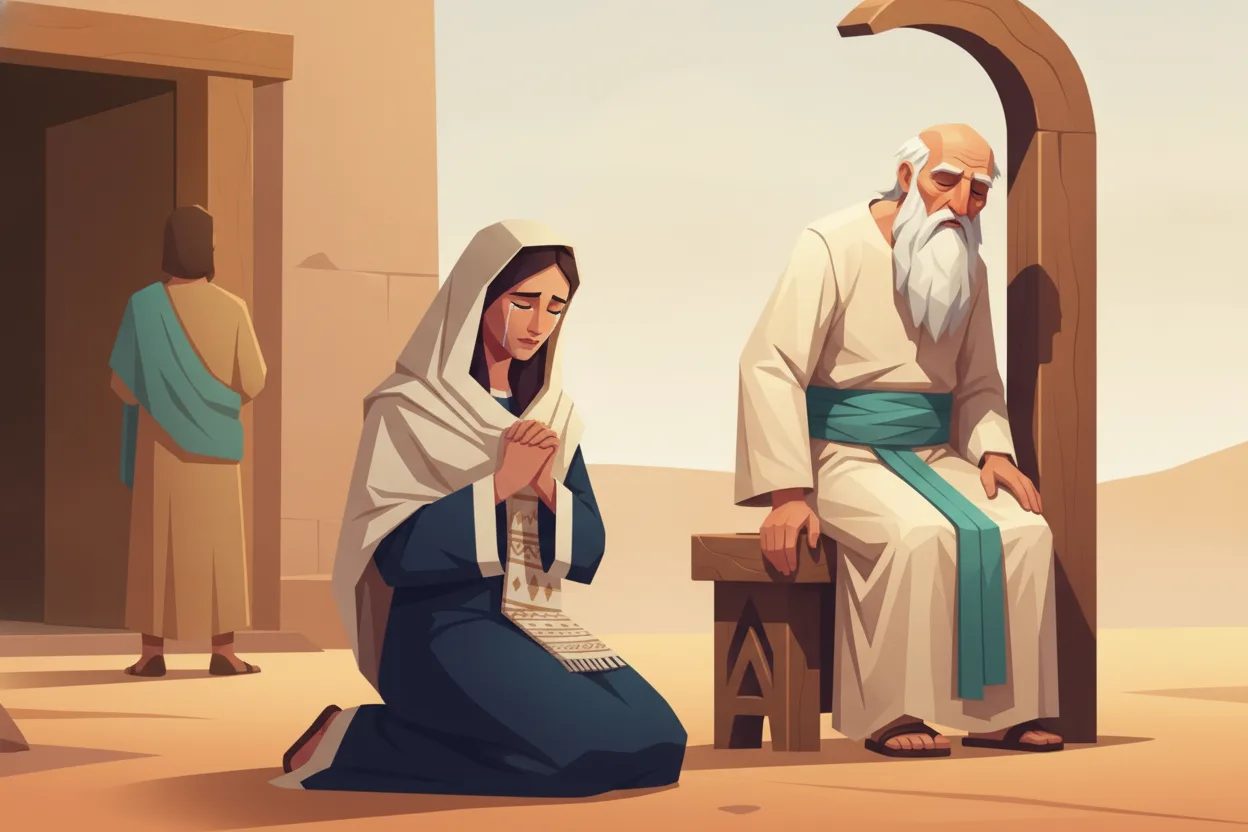
1 Samuel 1:9-18
Hannah's vow at the temple
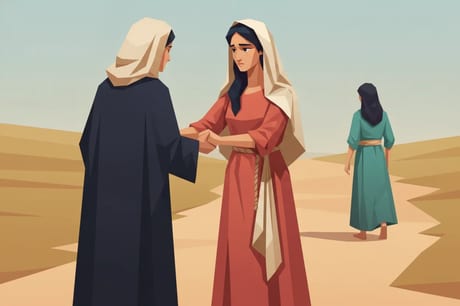
Hannah has no child. Every year, it hurts her deeply. Her husband Elkanah loves her, but Elkanah's other wife mocks her. One day, after the meal, Hannah gets up and goes to pray in the temple at Shiloh.
She cries a great deal. She speaks to God in her heart, without making a sound. Only her lips move. The priest Eli watches her and thinks she is drunk. He says to her: "Stop drinking!" Hannah answers: "No, I am not drinking. I am sad. I was telling God about my trouble."
Eli understands. He says to her: "Go in peace. May God grant what you have asked." Hannah feels relieved. She goes back to eat, and her face is no longer sad. No one yet knows what God will do. But Hannah already senses that someone has heard her.
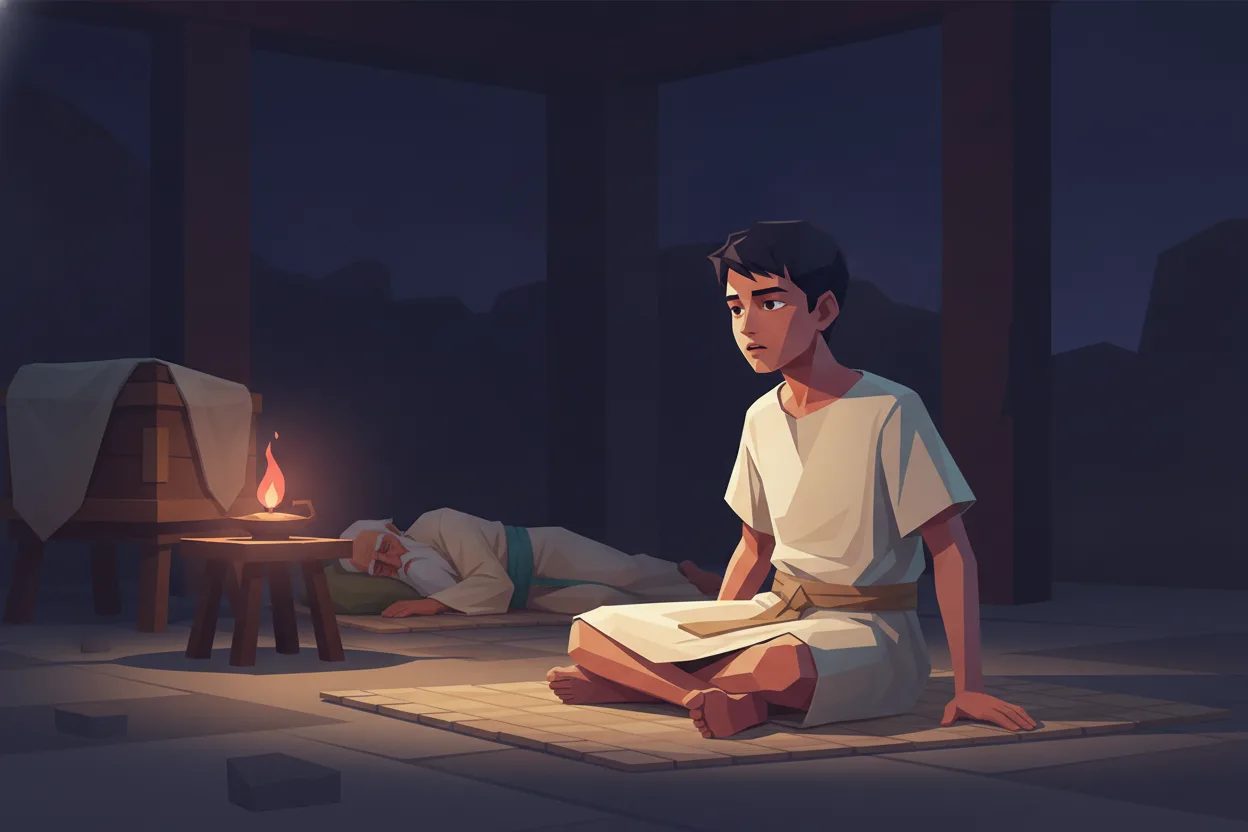
1 Samuel 3:1-10
Samuel called in the night
In the temple at Shiloh, night falls. A small lamp still burns near the sacred chest. Young Samuel sleeps close by, not far from the high priest Eli, who has grown almost blind with age.
Suddenly, a voice calls: "Samuel!" The boy gets up and runs to Eli. "Here I am, you called me?" But Eli answers: "I said nothing, go back to sleep." This happens once, then twice. Eli then understands that it is the Lord speaking to the boy.
He tells Samuel: "If the voice calls you again, answer: Speak, Lord, your servant is listening." The voice comes back a third time. Samuel answers as Eli taught him. God then begins to speak to him, for the first time. So begins, in the darkness of the temple, a new word that had not been heard in Israel for a long time.
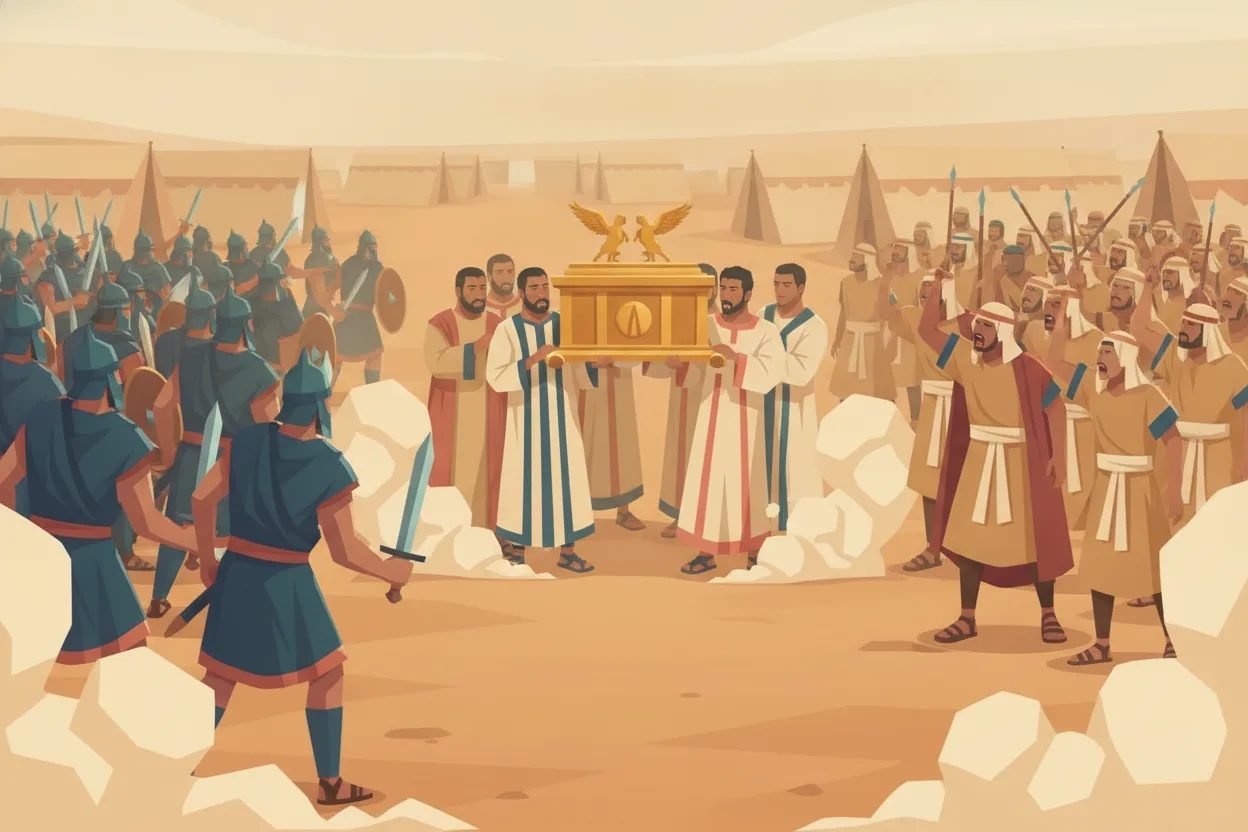
1 Samuel 4:1-11
The ark captured, Eli's sons killed
The Israelites fight the Philistines. The battle turns bad. Four thousand men fall on the field.
The elders of Israel gather and ask: "Why has the Lord let us be defeated today?" Then they have an idea. "Let's bring the ark of the covenant from Shiloh! Let it come among us, and it will save us from our enemies."
The ark is brought, carried by Hophni and Phinehas, the two sons of the priest Eli. When it reaches the camp, all Israel lets out a great shout, so loud that the ground shakes. The Philistines are afraid: "A god has come into their camp!" But they fight anyway, with courage.
The battle starts again. This time, it is a disaster. Thirty thousand soldiers of Israel die. The ark of God is captured. Hophni and Phinehas are killed, on the same day.
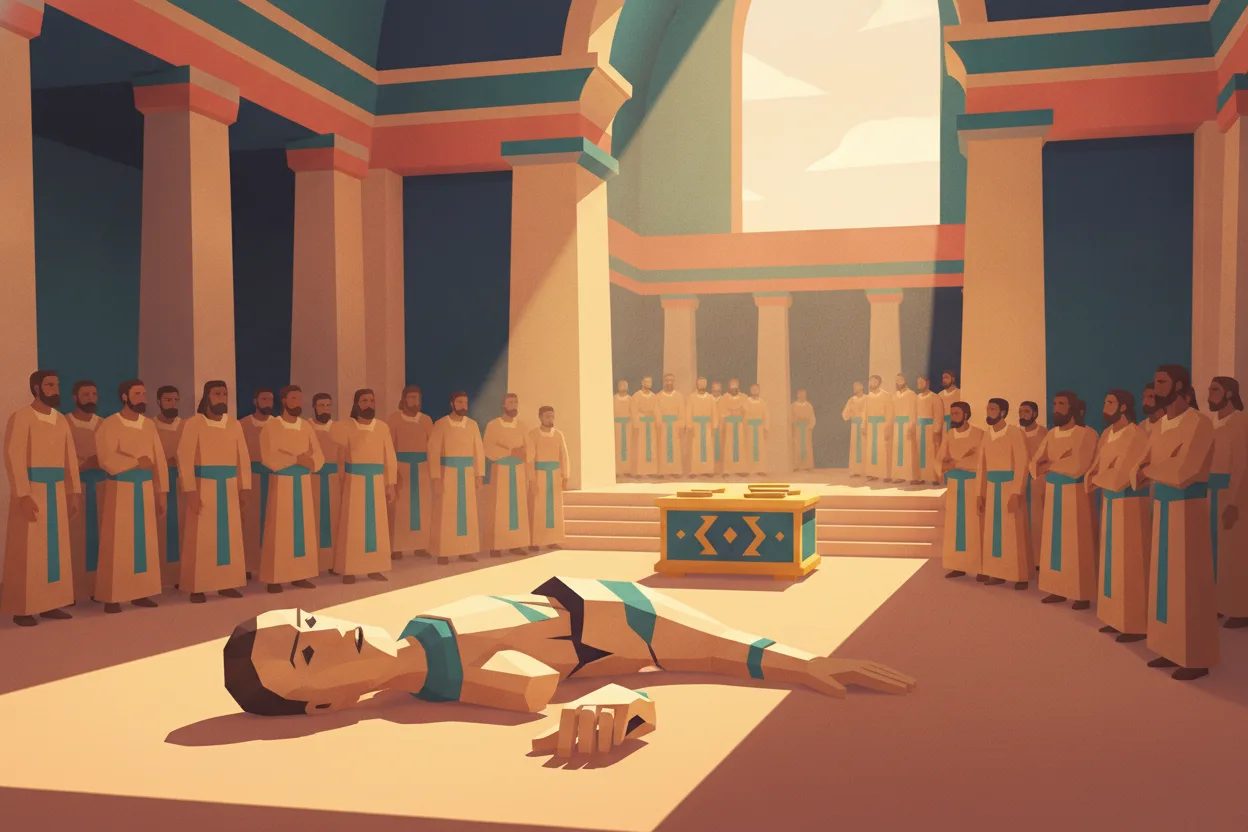
1 Samuel 5:1-4
Dagon falls before the ark
The Philistines have taken the sacred chest of the Israelites. They bring it to the city of Ashdod, into the temple of their god Dagon. They set the chest right next to the statue, like a trophy of war.
The next morning, the priests enter the temple. Surprise: Dagon has fallen. He lies on the ground, face down, right in front of the Lord's chest. The priests pick him up and put him back in his place.
The following morning, they come back. He has fallen again. Dagon is again on the ground, before the chest. But this time, his head and his hands are broken, shattered on the threshold of the door. Only his body remains. The priests understand: this god of stone cannot stand before the God of Israel, even when that God seems a prisoner.
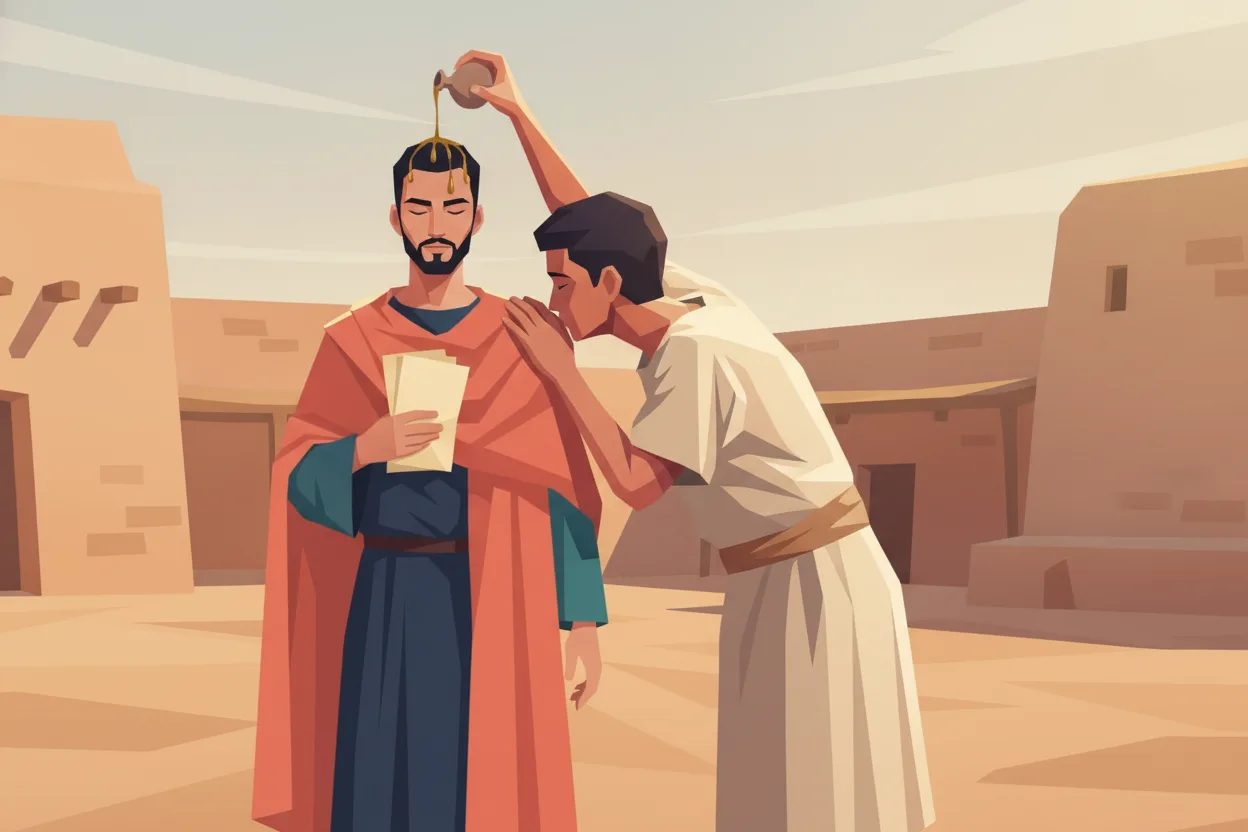
1 Samuel 10:1
Samuel anoints Saul in secret
Saul is looking for lost donkeys. His father has misplaced them, and the young man roams the hills without finding them. Tired, he decides to go see a man of God, a certain Samuel, to ask for advice.
Samuel welcomes him. He already knows, for God has told him: this man will be the leader of Israel. So Samuel takes a flask of oil. He pours it on Saul's head, and he kisses him.
"The Lord has anointed you to be leader over his people," says Samuel. "Your father's donkeys have been found. Do not worry about them anymore. But know this: all Israel now has its eyes turned toward you."
Saul remains silent. He left to look for lost animals. He leaves as king.
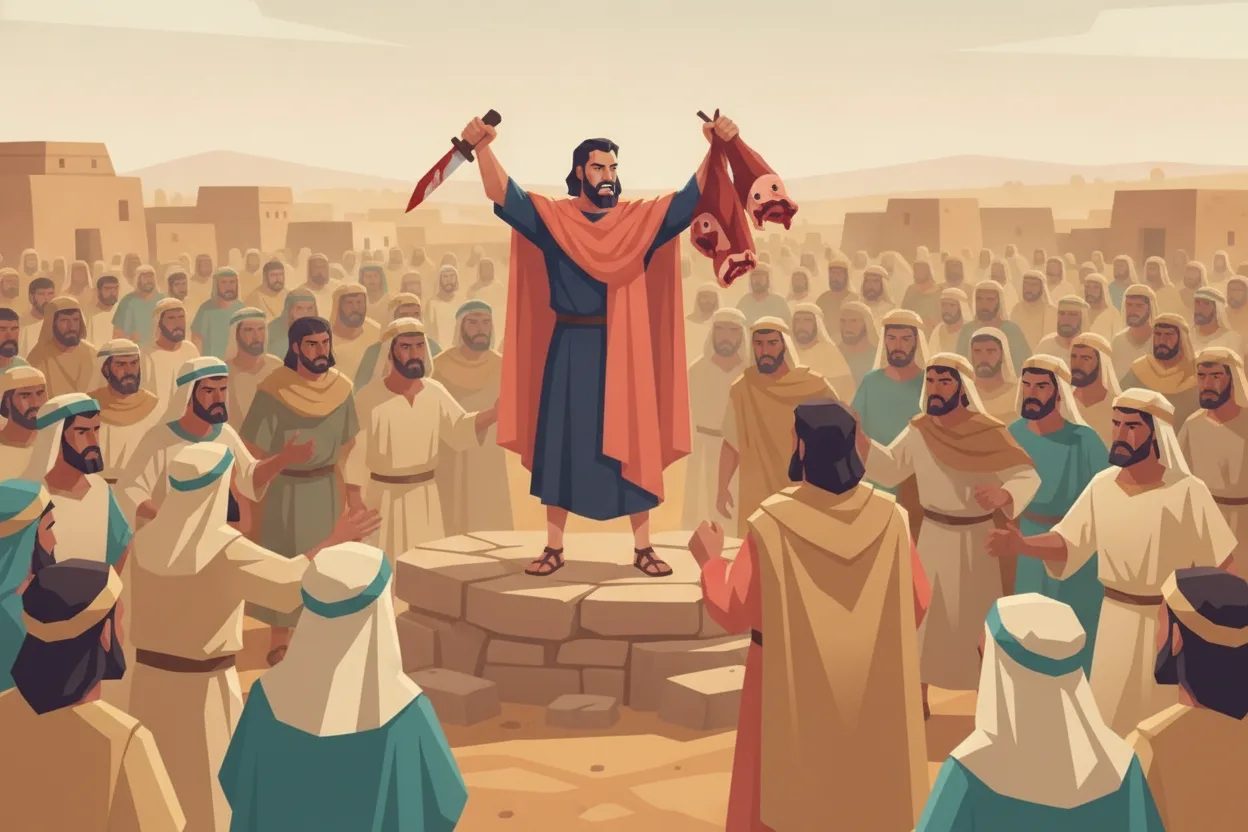
1 Samuel 11:6-11
Saul rescues Jabesh-gilead
Saul comes back from the fields with his oxen. He learns that the people of Jabesh in Gilead are threatened by Nahash, king of the Ammonites. This king wants to gouge out the right eye of every man in the city.
Hearing this, the spirit of God seizes Saul. A great anger rises in him. He takes a pair of oxen, cuts them into pieces, and sends the pieces throughout Israel with this message: "Whoever does not follow Saul and Samuel into battle, this is what will happen to his oxen!"
The fear of God falls on the people. They all gather as one man: three hundred thousand men of Israel, thirty thousand of Judah. Saul organizes them into three groups. During the night, they surprise the Ammonite camp. In the morning, they strike until the heat of the day. The survivors scatter, none remain together. Jabesh is saved, and Saul truly becomes king in everyone's eyes.
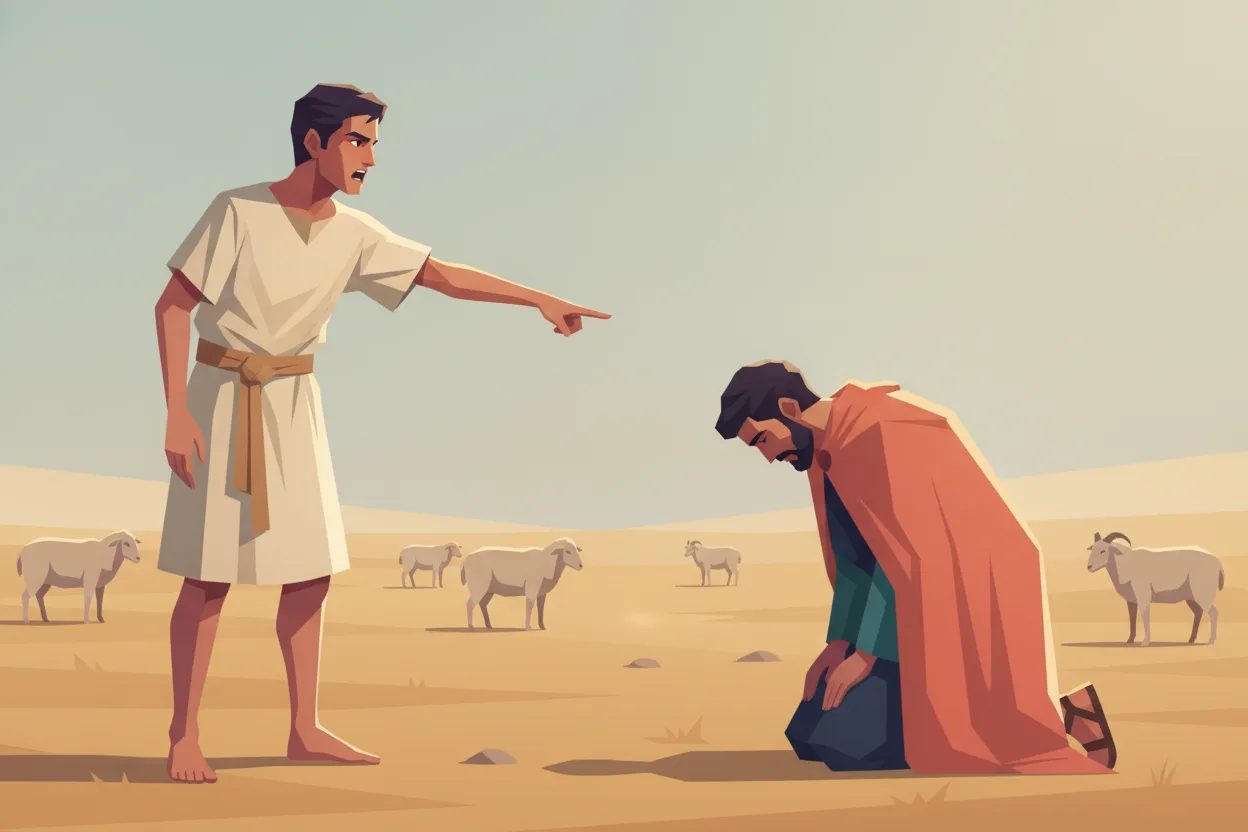
1 Samuel 15:10-23
Samuel confronts Saul after Amalek
The Lord speaks to Samuel. He says: "I regret having made Saul king. He has disobeyed me."
Samuel goes to find Saul. Saul has just fought the Amalekites. He calls out from afar: "May the Lord bless you! I have obeyed the order."
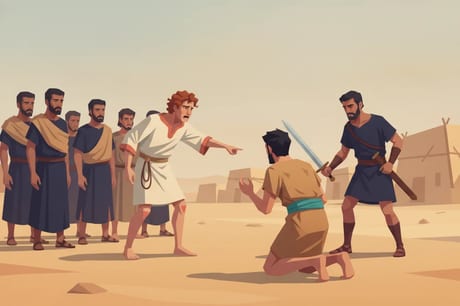
But Samuel hears bleating and lowing. "Then why these sheep, these oxen?" he asks. Saul answers: "The people kept them to offer them as a sacrifice."
Samuel cuts him off: "The Lord prefers obedience to sacrifices! You have rejected his word, he rejects you as king."
Saul admits his fault. He begs to be honored still before the people. But the sentence has fallen. Saul's reign is coming to an end.
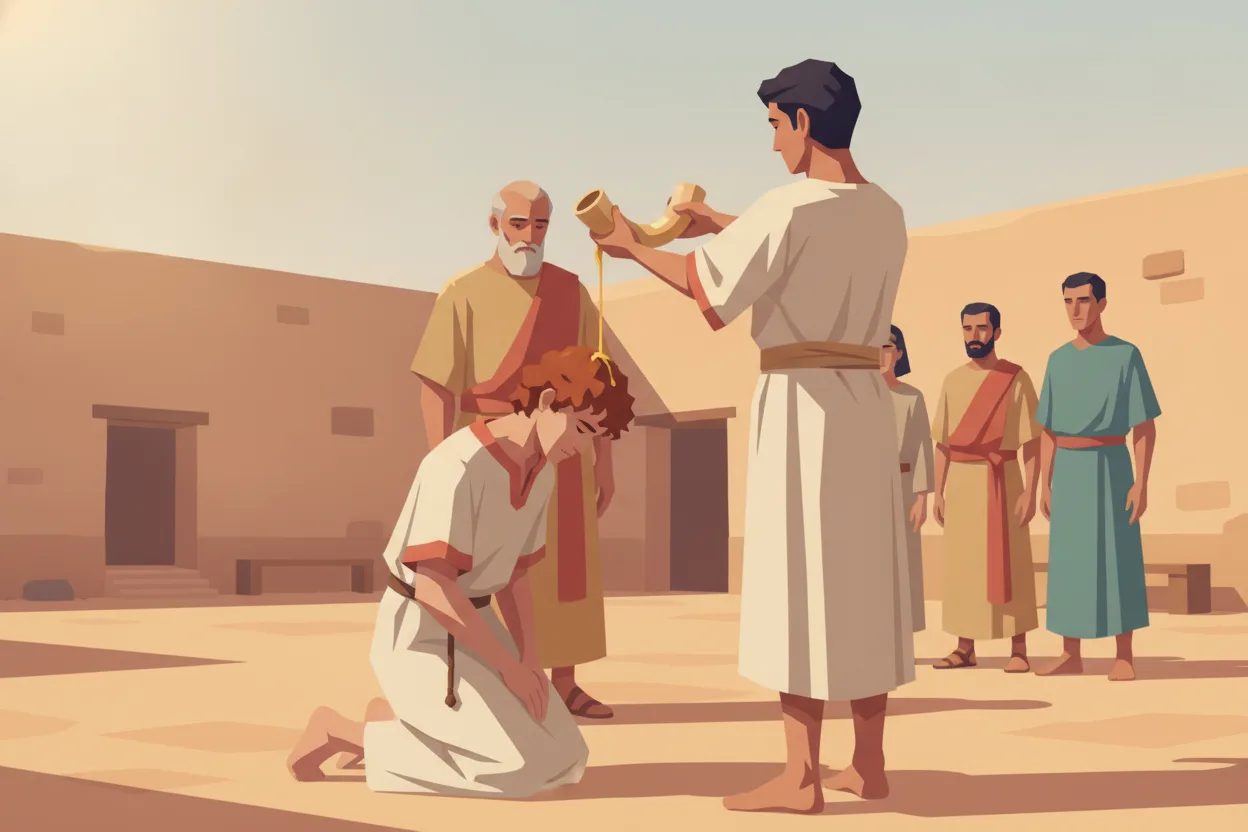
1 Samuel 16:1-13
David anointed among his brothers
God speaks to Samuel. Saul has failed. A new king is needed. God says: "Go to Jesse, at Bethlehem. I have chosen one of his sons."
Samuel arrives. Jesse presents his sons, one after another. The first is tall and strong. Samuel thinks: "This is the one." But God says: "No. Men look at the face. I look at the heart."
Seven sons pass before Samuel. None is chosen. Samuel asks: "Do you not have another son?" Jesse answers: "There remains the youngest. He is tending the sheep." He is sent for. It is David. He has bright eyes and a lively look.
God says to Samuel: "This is the one." Samuel takes the oil and pours the anointing on David's head, before his brothers. From that day on, the Spirit of God stays with David.
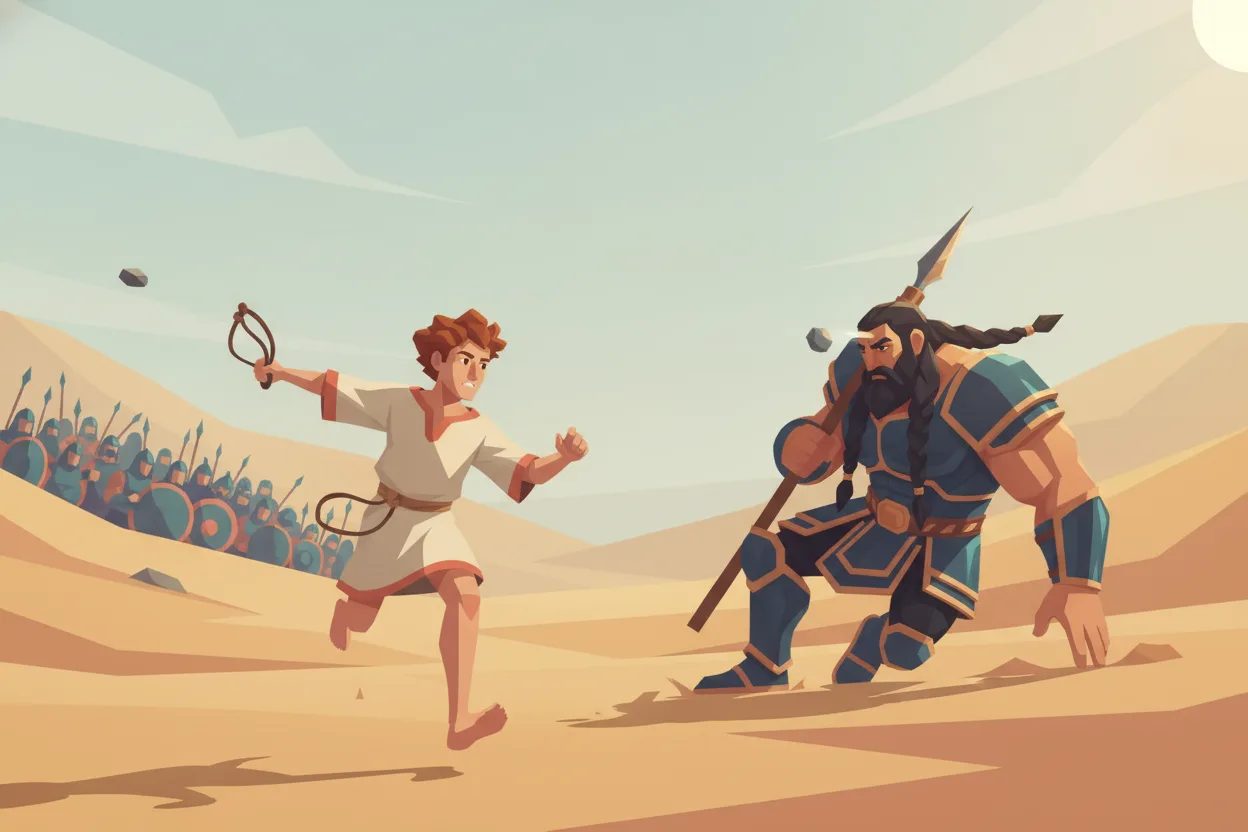
1 Samuel 17:40-51
David defeats Goliath
David sets aside the heavy armor that Saul offers him. He takes his staff, chooses five smooth stones from the stream, and walks toward Goliath with his sling in hand.
The giant sees this young shepherd coming and mocks him. "Am I a dog, that you come to me with a stick?" David answers without fear: "You come to me with a sword, but I come to you in the name of the Lord of hosts. Today, the Lord will hand you over into my hands."
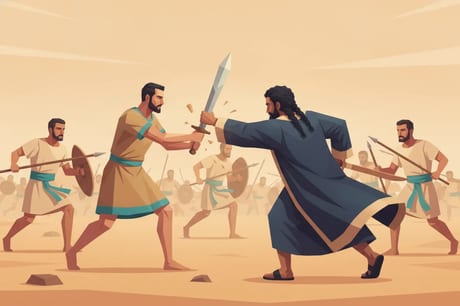
Goliath moves forward. David runs toward him, puts a stone in his sling and throws it. The stone strikes the giant's forehead, and he falls face down on the ground. David runs, seizes Goliath's sword and cuts off his head. Seeing their hero dead, the Philistines flee.
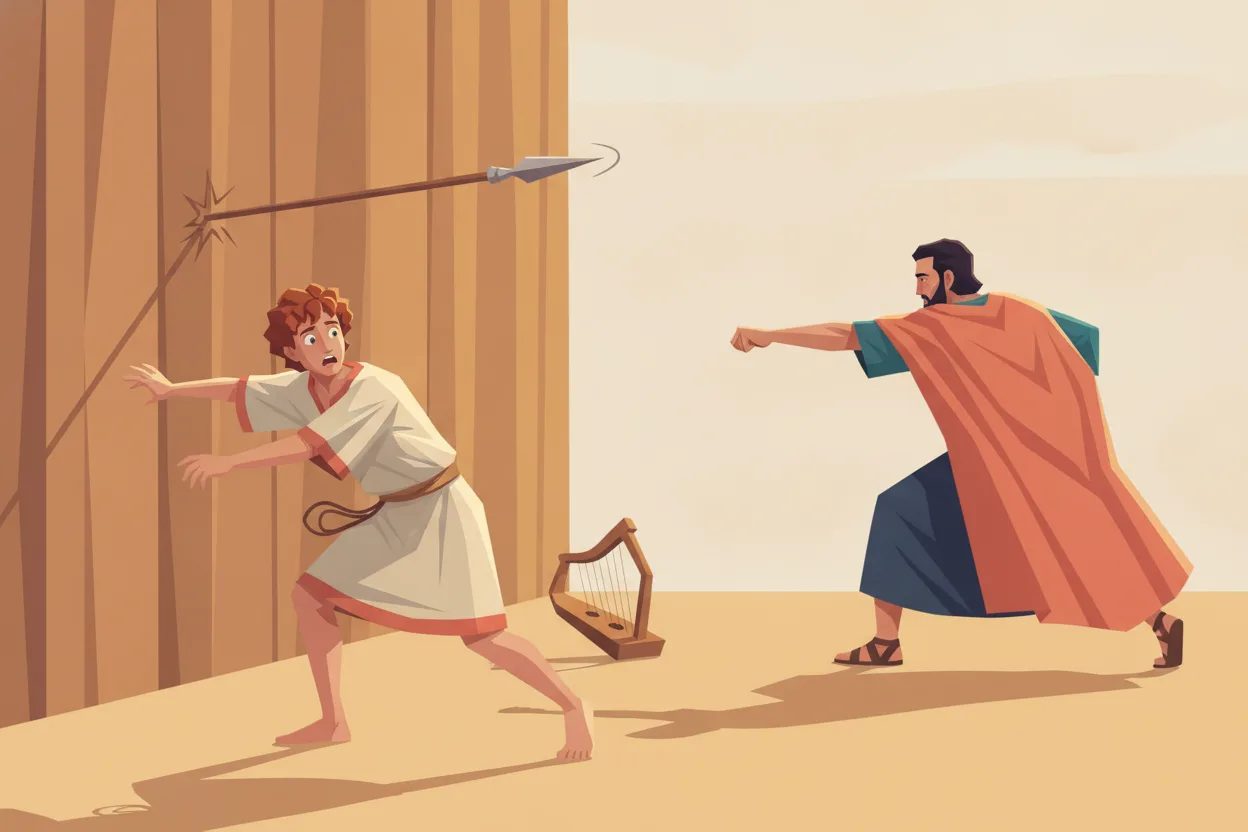
1 Samuel 18:10-11
Saul hurls his spear at David
The next day, an evil spirit seizes Saul. He grows agitated in his house, caught in a dark fury. David is there, as every day, playing the harp to calm the king.
Saul holds his spear in his hand. Suddenly, without a word, he raises it and hurls it with all his strength toward David. He thinks: "I will pin him to the wall!" But David dodges. Once, then a second time. The spear sticks into the wood.
David escapes, his heart pounding. That day, something breaks. The king he served with love has become a deadly threat. From then on, David will know no rest. He will have to flee, hide, run across the whole land, far from the court, far from Saul, to stay alive.
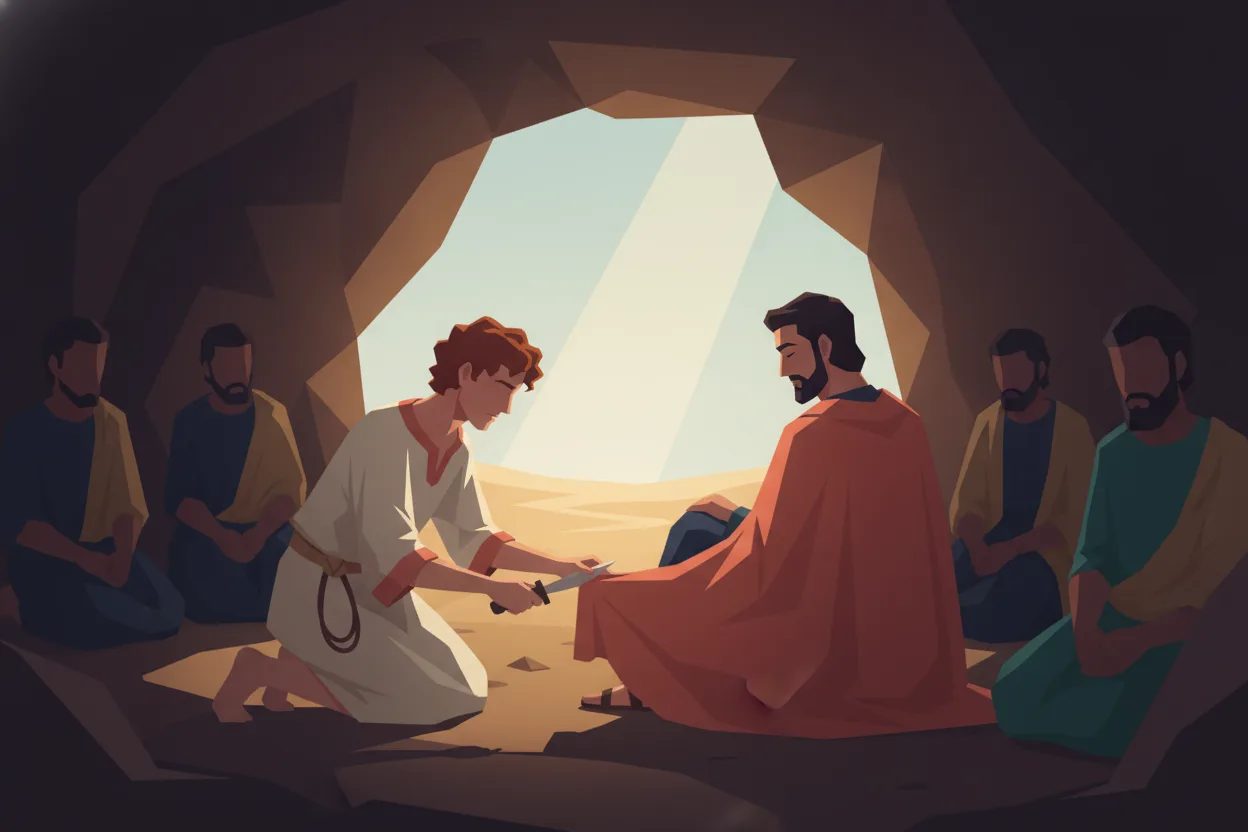
1 Samuel 24:3-11
David spares Saul in the cave
Saul pursues David in the desert. With three thousand soldiers, he enters a cave to rest. He does not know that David and his men are hiding in the back, in the shadows.
David's men whisper: "This is the moment! God is delivering your enemy into your hands." David approaches silently. He cuts off just a piece of Saul's cloak, without touching him, without harming him.
But at once, David feels remorse. He says to his men: "I cannot raise my hand against him. He is the king chosen by the Lord."
Later, Saul comes out of the cave. David follows him and calls out: "My father, look at this piece of your cloak in my hand! I could have killed you, but I spared you. I will not raise my hand against the Lord's anointed."
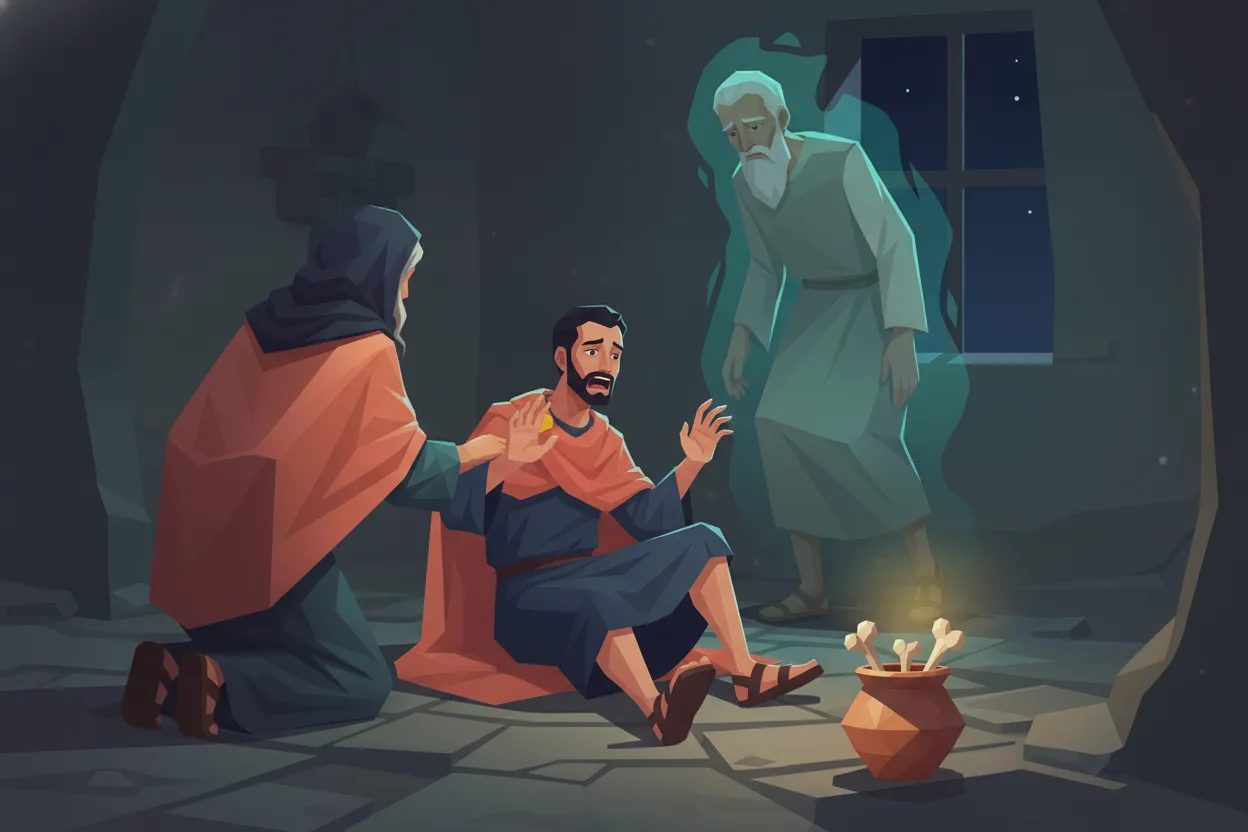
1 Samuel 28:7-20
Saul consults the medium of Endor
Saul is afraid. The Philistine army camps before him, immense. He prays to God, but God no longer answers, neither through dreams nor through priests. So Saul changes his face. He tells his servants: "Find me a woman who speaks to the dead." They find one for him, at Endor.
Night falls. Saul disguises himself so that no one will recognize him. He asks the woman to bring up the spirit of Samuel, the dead prophet. She agrees, then suddenly recognizes the king and trembles with fear. But the spirit of Samuel truly appears, and he is angry: "Why do you disturb me? God has left you, he has become your enemy."
Samuel announces the terrible truth: tomorrow, Saul and his sons will die in battle, and Israel will be defeated. Saul collapses to the ground, drained of strength. He has eaten nothing for a day. The woman and his servants lift him up and prepare him a meal, before the battle that will seal his end.
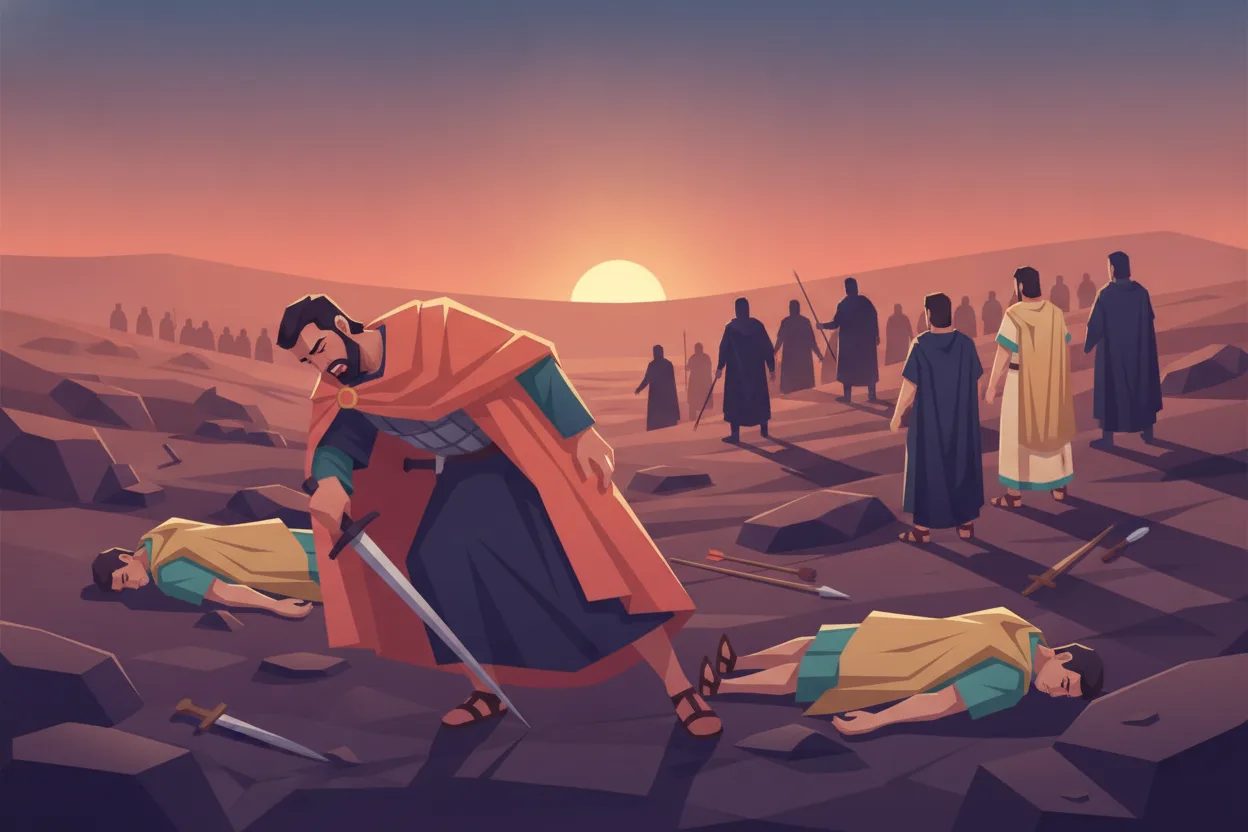
1 Samuel 31:3-6
Saul's death on Mount Gilboa
The battle turns bad. The Philistine archers aim at Saul and wound him gravely. The king of Israel falls, wounded.
Around him, his sons die one after another. Jonathan, his eldest son, falls in battle. His brothers Abinadab and Malkishua also perish. Saul finds himself alone, surrounded by enemies.
He calls to his armor-bearer. "Draw your sword and run me through," he says, "before these men capture me and mock me." But the man is afraid and refuses to obey. So Saul takes his own sword and falls on it. Seeing their king dead, the men flee. That day, Saul dies with his three sons. The first king of Israel disappears in defeat, and with him, an entire reign comes to an end. A page turns for Israel.
Characters in This Chapter

Last judge and prophet who anointed both Saul and David as kings

First king of Israel, whose disobedience led to his rejection by God

Shepherd boy anointed as future king, man after God's own heart

Saul's son who became David's closest friend despite the rivalry

Samuel's mother who prayed for a son and dedicated him to God