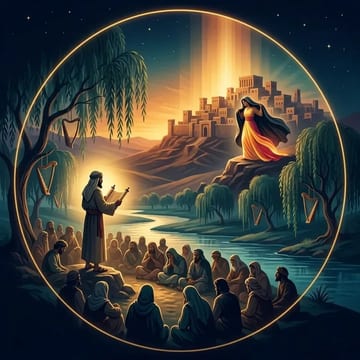
Book of Baruch Baruch, written by Attributed to Baruch, Jeremiah's scribe; unknown Jewish authors
Create a PlanBaruch presents itself as a book read by Jeremiah's scribe to the exiles in Babylon and sent to Jerusalem. It opens with a long confession of the sins that brought about the fall of the city, continues with a poem on wisdom, which God gave to Israel as the book of his commandments, and ends with Jerusalem mourning her deported children and then being told to put on the garment of joy at their return. A sixth chapter adds the Letter of Jeremiah, a sustained mockery of the idols of Babylon.
Chapters in Baruch
Outline of Baruch
Israel admits that it ignored the prophets and earned the curses of the law, and recalls God's promise of return and of an everlasting covenant.
After the end of the prayer, a poem asks where wisdom lies: not with the mighty or the wise of the nations, but with God, who gave her to Jacob.
Wisdom is the law; Jerusalem mourns her exiled sons as a widow, then is told to rise, put on glory and watch them come home.
Key Themes in Baruch
Honest Confession
The exiles do not blame Babylon for their misfortune: 'to the Lord our God belongeth righteousness', and the shame belongs to them, their kings and their fathers.
Wisdom Given as the Law
No empire, merchant or giant could find wisdom; God alone knows her, and he has given her to Israel in the book of his commandments.
Jerusalem as Mother
The city speaks as a widow robbed of her children, then is addressed as a bride clothed in glory, a picture that carries the whole movement from grief to return.
Key Verses in Baruch
Hear, Israel, the commandments of life: give ear to understand wisdom.
The opening of the wisdom poem, which echoes the Shema and turns from confession to instruction.
Afterward did he shew himself upon earth, and conversed with men.
In context, wisdom given to Israel dwells among men; the Church Fathers read the line as a prophecy of the Incarnation.
This is the book of the commandments of God, and the law that endureth for ever: all they that keep it shall come to life; but such as leave it shall die.
The poem's answer: the wisdom no one could find is the law God has already given.
Characters in Baruch


Locations in Baruch


Christ in Baruch
Wisdom Living Among Men
Baruch says that wisdom 'conversed with men'; John says that the Word was made flesh and dwelt among us, and early Christian writers often read the two together.
JHN 1:14Who Has Gone Up to Heaven?
Baruch's questions about going up to heaven or over the sea to fetch wisdom draw on Deuteronomy 30; Paul uses the same passage to say that the word is near, in Christ.
ROM 10:6-8Every Hill Made Low
The levelling of hills and valleys for the return of the exiles echoes Isaiah 40, which the Gospels apply to John the Baptist preparing the way of the Lord.
LUK 3:4-6Frequently Asked Questions
You are readingKing James Version