Cracking the Color Code
What the Hues of Revelation Really Mean
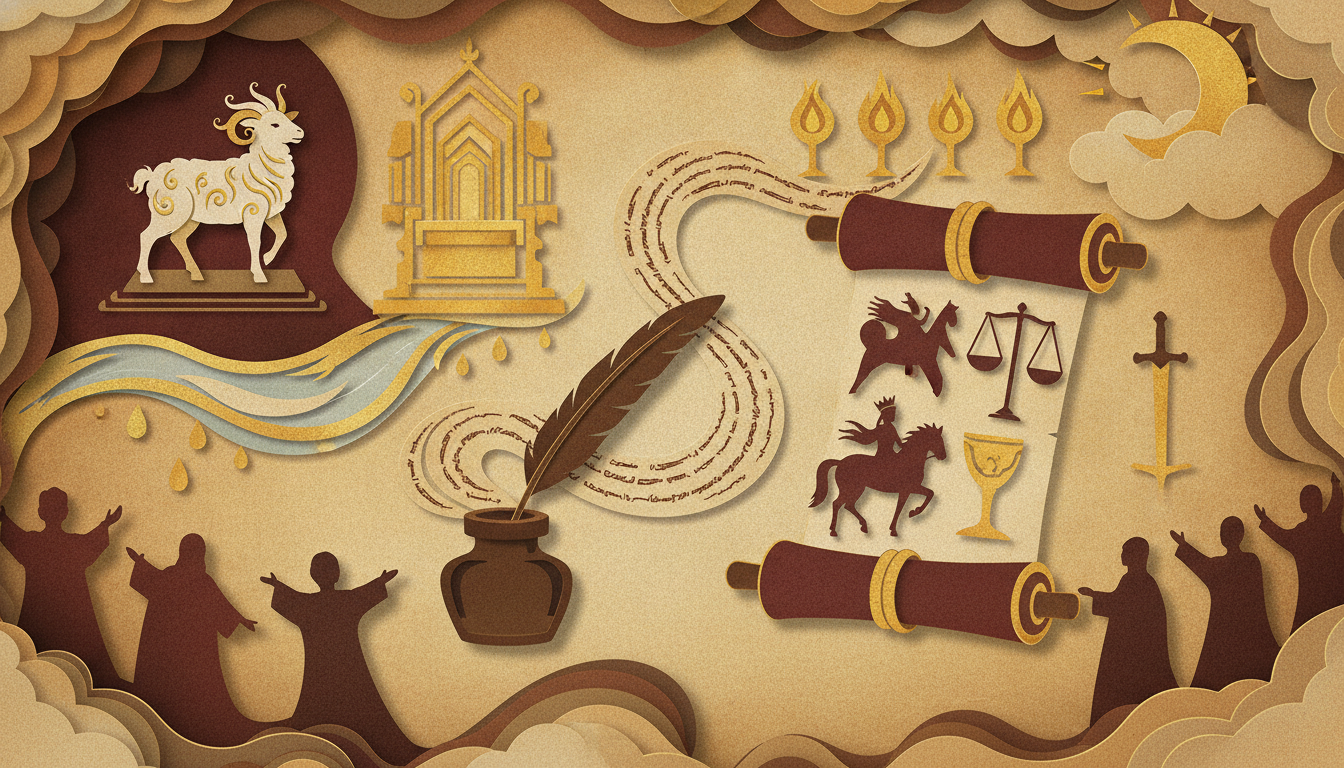
When John sat down to write what he'd seen in his vision, he didn't just describe events. He painted them. White horses, red dragons, black horses, golden crowns. These weren't random details thrown in for dramatic effect.
The colors bypass logic and strike the imagination, requiring no degree to understand red as blood or pale as death.
Think about it. You can read a thousand words about purity, or you can see someone clothed in brilliant white. One hits differently, doesn't it? John knew his audience would catch these visual cues instantly, especially since
the book's symbols are heavily based on Old Testament themes
they already knew by heart.
White: More Than Just Purity
White occurs 17 times in Revelation and stands for purity, cleanliness, and righteousness.
But there's something deeper going on here. When John describes Christ on a white horse in Revelation 19, he's not just saying Jesus is pure. He's declaring victory.
"I looked, and there before me was a white cloud, and seated on the cloud was one like a son of man with a crown of gold on his head and a sharp sickle in his hand."
White represents victory and holiness, which is why the martyrs get white robes. They didn't just make it through. They conquered. The color itself becomes a proclamation, a visual shout that good wins.
You see this throughout Scripture.
Isaiah 1:18 promises that though sins be scarlet, they shall be "white as snow."
John's readers would've made that connection immediately.
Red and Black: The Horsemen's Warning
The four horsemen get a lot of attention, but have you stopped to think about why their horses are specifically white, red, black, and pale?
The white horse represents religious deception, the red represents war and division, the black represents famine and the disasters that cause it, and the pale horse represents disease.
Red signifies bloodshed, sinfulness, and war, while
black represents famine, death, and sorrow.
These aren't subtle hints. They're alarm bells in visual form. When a blood-red horse appears, you don't need footnotes to know something violent is coming.
Language Clue
The Greek word for the pale horse's color is "chloros," the same root we get "chlorophyll" from. It describes a sickly greenish-pallor, the color of death and decay. Some translations use "pale," others "ashen," but both capture that unsettling hue of something lifeless.
The Scarlet Woman and Purple Corruption
Here's where things get really interesting. When John describes the harlot of Babylon in Revelation 17, she's draped in purple and scarlet. Why those colors specifically?
Purple and scarlet represent royalty and luxury, but also corruption and immorality.
It's brilliant, really.
Scarlet functions as a sign of royalty but also sinfulness.
John's painting a picture of wealth gone rotten, power corrupted. She's dressed like a queen but acting like... well, he calls her a harlot for a reason.
The original readers would've gotten another layer too. Purple dye in the ancient world cost a fortune. Only the wealthy elite could afford it. So when John dresses this symbolic figure in purple and scarlet, he's saying something about corrupted power and false religious systems that look impressive on the outside.
Gold: When Metal Becomes Sacred
Gold represents value, divinity, and sacredness, appearing in descriptions of the heavenly city, altar, and crowns.
But count how many times gold shows up in the throne room scenes of Revelation 4. The streets, the crowns, the altar, even the bowls holding prayers.
| Color | Primary Meaning | Where It Appears |
|---|---|---|
| White | Victory, Purity | Robes of saints, Christ's horse |
| Red | War, Bloodshed | Dragon, second horseman |
| Black | Famine, Death | Third horseman |
| Purple/Scarlet | Royalty, Corruption | Babylon's harlot |
| Gold | Holiness, Divine Worth | New Jerusalem, crowns |
Gold isn't just valuable. It's what you use to build God's dwelling place. Remember the Tabernacle? The temple? Both gleamed with gold. When John sees the New Jerusalem coming down with streets of gold, he's seeing Eden restored, the place where heaven and earth finally reunite.
Numbers: The Other Secret Language
Colors aren't the only code John uses.
Seven represents perfection, fullness, and completion, appearing as seven churches, seals, trumpets, and bowls.
You can't read three chapters without tripping over the number seven.
Twelve represents God's people, both Israel with its 12 tribes and the Church with its 12 apostles.
That's why
the 24 elders equal 12 tribes plus 12 apostles, representing heavenly worship.
And then there's 666.
666 signifies imperfection, incompleteness, and ultimate evil as the number of the beast.
It falls short of seven (perfection) three times over. It's deliberately, catastrophically incomplete.
Why These Codes Matter
- They made the message accessible to first-century Christians who knew Old Testament imagery
- Colors communicate instantly what would take paragraphs to explain
- Numbers create patterns that reinforce theological truths
- The visual language transcends literacy barriers and cultural differences
Reading Between the Rainbow
There's one more color detail that's easy to miss. In Revelation 4,
an emerald rainbow surrounds God's throne, signifying the rainbow covenant and promise of God.
Remember Genesis? God put a rainbow in the sky as a covenant sign after the flood.
John's telling us that even in the middle of all this judgment, all these seals breaking and trumpets blaring, God's promise still holds. The rainbow's still there. He hasn't forgotten his covenant.
It's autumn now, and you know how the leaves turn? Brilliant reds, deep golds, eventually fading to brown. There's a kind of beauty even in the dying, a reminder that seasons change and nothing stays the same. That's Revelation in a nutshell. The current world's leaves are turning, but spring's coming. A new heaven and new earth where
white represents victory and holiness, where the tree of life grows again, where everything broken gets restored.
Why John Chose Paint Over Plain Speech
Apocalyptic writing often uses dramatic language like beasts, horns, numbers, and cosmic events to communicate spiritual realities.
But why not just say it straight? Why all the color-coded symbolism?
Because some truths are too big for plain words. Try explaining what complete holiness looks like, or what absolute evil feels like, or what it means when all creation finally gets made right. You can't just list facts. You need images that burn into memory.
Reading Tip
Next time you read Revelation, grab some colored pencils. Mark the colors as they appear. You'll start seeing patterns you never noticed before, connections between chapters that suddenly make sense.
When John writes about someone in dazzling white or a beast the color of blood, he's not being poetic for poetry's sake. He's giving you a visual shorthand that works whether you're a first-century slave in Asia Minor or a 21st-century reader trying to make sense of prophecy.
Revelation's symbols are often "tensive" symbols, open-ended to some degree in that they can represent several conceptions or ideas.
That white horse in chapter 6? It can mean false peace. The white horse in chapter 19? True victory. Same color, different context, both meanings valid.
The Palette of Hope
Here's what gets me about all these colors and numbers: they're not random.
Revelation is filled with rich and layered symbolism, often borrowing from Old Testament imagery, with each symbol serving to communicate deeper spiritual truths about God's plan for the end.
Every shade matters. Every number counts. From the white robes that promise victory to the golden city that signals God dwelling with humanity again, John's painting a picture of how the story ends. And spoiler alert: it ends in color. Not the pale green of death, not the scarlet of corruption, but the brilliant white of victory and the gold of God's presence.
That's the code worth cracking.